Short answer
Carpet pythons, common tree snakes, yellow-faced whip snakes and white-crowned snakes are found throughout Brisbane. The highly venomous eastern brown snake is uncommon in settled suburbs but does turn up. Don't approach any snake or try to identify it up close: back away, keep children and pets inside, and call a licensed snake catcher. Snakes are protected in Queensland.
Covers Queensland.
- Legal status
- Protected; killing one is an offence[2]
- Who removes them
- A licensed snake catcher[3]
- Snake inside?
- Close inside doors, open outside doors[2]
- Bitten?
- Call 000, apply a pressure bandage[5]
On this page
Brisbane has many snake species. Some are dangerously venomous, some are harmless to people, and several look alike. That is why the first rule from Queensland’s own guide is simple: never approach a snake, and never assume it is non-venomous.[1]
Snakes you’re most likely to see
Carpet pythons, common tree snakes, yellow-faced whip snakes and white-crowned snakes are all found throughout Brisbane. The white-crowned snake is one of the city’s most common snakes, including in the inner city, and often turns up in compost heaps and damp gardens.[1]
Four snakes Brisbane residents ask about
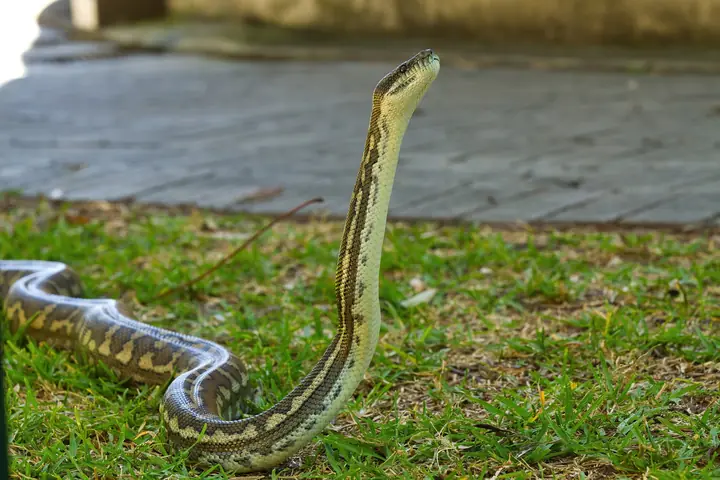
Carpet python
Morelia spilota
- Non-venomous
- Pale blotches edged in black, with yellow spots
- Found throughout Brisbane, even the city centre
- Mainly active at night
Source [1]
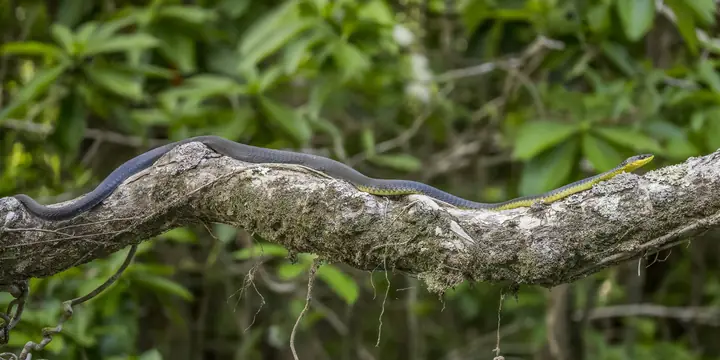
Common tree snake
Dendrelaphis punctulata
- Very slender; colour varies a lot
- Shows bright blue skin between scales when disturbed
- Cream, yellow or light blue underside
- Found throughout Brisbane, active by day
Source [1]
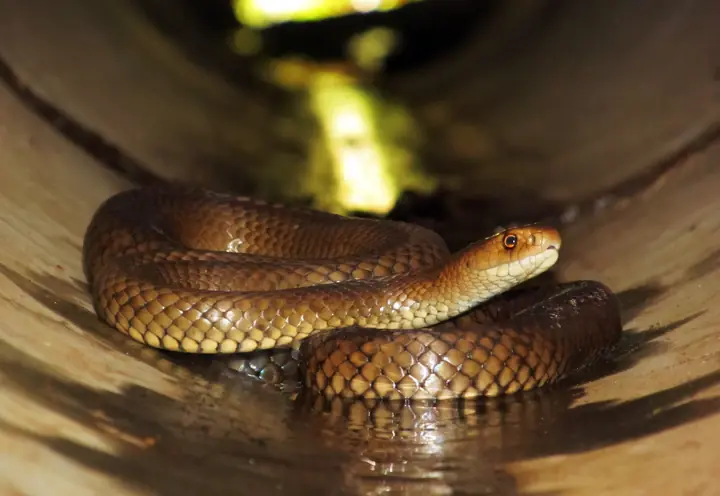
Eastern brown snake
Pseudonaja textilis
- Highly venomous
- Light tan to nearly black; cream to orange belly with blotches
- Uncommon in settled Brisbane, more common in bushland and rural areas
- Rears up in an S-shape when provoked
Source [1]
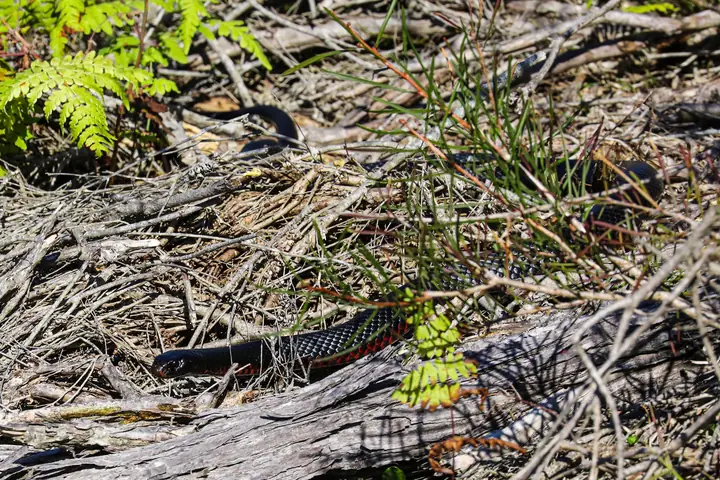
Red-bellied black snake
Pseudechis porphyriacus
- Venomous
- Shiny black above, red (sometimes pink or white) belly
- Now mostly in cooler areas north and south of the city
- Usually near water
Source [1]
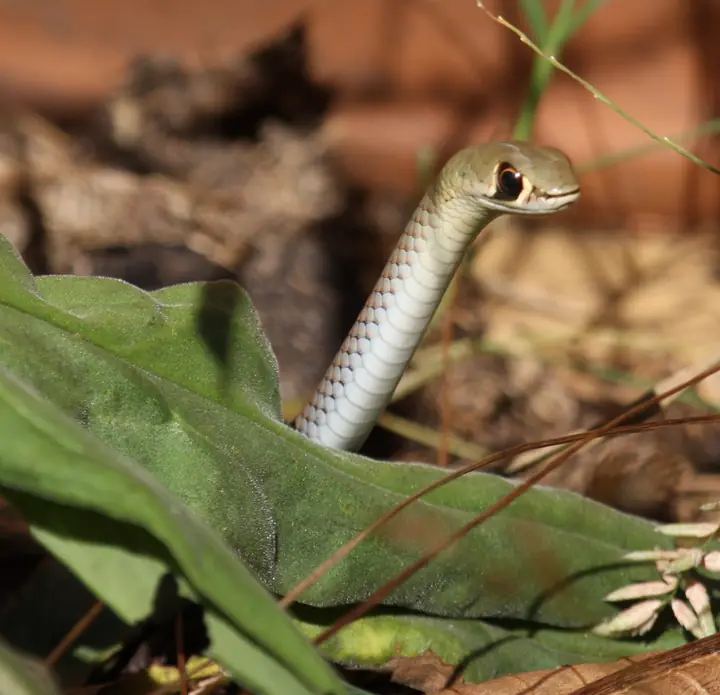
Others you may come across:
| Snake | Venom (Queensland’s guide) | How to recognise it | Where |
|---|---|---|---|
| Yellow-faced whip snake | Venomous; large ones need caution | Yellow-edged dark bar around the nose, dark comma-shaped streak from the eye, slender with a whip-like tail | Throughout Brisbane; active by day and usually flees quickly |
| White-crowned snake | Venomous, not dangerous to people | Dark grey with a broad white band around a black head | One of Brisbane’s most common snakes |
| Eastern small-eyed snake | Venomous | Shiny black back and sides, pink belly that doesn’t extend up the sides, tiny eyes | Common throughout Brisbane; hides under tin, rocks and logs |
| Black-bellied swamp snake | Venomous; treat bites from large ones with caution | Olive to grey above, grey to black belly, two pale lines on each side of the face | Wet areas, creeks and wetlands throughout Brisbane |
| Brown tree snake | Mildly venomous | Brown to reddish-brown with darker cross-bands, large yellow eyes | Trees, at night |
All descriptions are from the Queensland Government’s guide to south-east Queensland snakes.[1] Individuals of one species can vary a lot, and the guide itself warns that some snakes are hard to identify.[1]
Look-alikes that cause confusion
- Eastern small-eyed snake and red-bellied black snake. Both are black above. The small-eyed snake’s pink belly doesn’t reach up its sides, and its eyes are tiny. Red-bellied black snakes are now mostly found in cooler areas north and south of the city.[1]
- Keelback and rough-scaled snake. The keelback, which eats frogs including cane toads, closely resembles the venomous rough-scaled snake. Telling them apart relies on a small scale on the side of the head, so treat both with caution.[1]
- Legless lizards. These are often mistaken for snakes. They have ear openings, broad tongues and small flaps where hind legs would be.[1]
Keelback or rough-scaled snake?
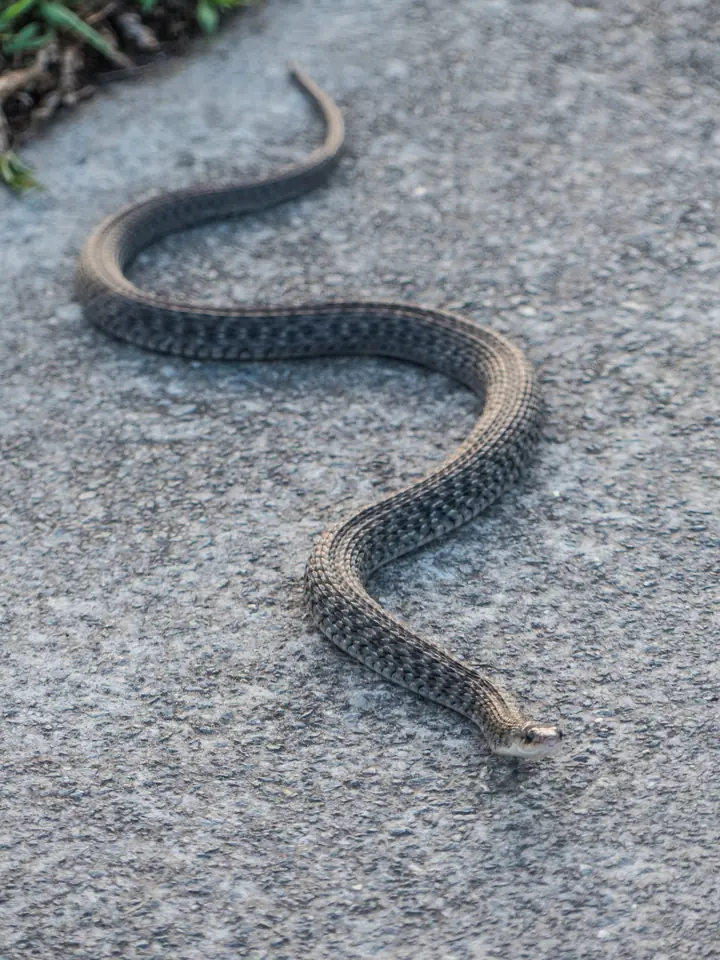
Keelback
Tropidonophis mairii
- Grey-green to brown with darker flecked cross-bands
- Strongly keeled scales
- Has a loreal scale on the side of the head, which separates it from the rough-scaled snake
- Creeks, rivers and marshes; eats frogs, including cane toads
Source [1]
 Photo to come
Rough-scaled snake
Tropidechis carinatus
- Venomous, potentially dangerous
- Olive to grey above with black flecks; greenish-grey belly
- Raised keels on its scales
- More common in Brisbane's hinterland, such as the D'Aguilar Range, often near water
Source [1]
If there’s a snake in your yard
- Back away to a safe distance and let the snake move on. Don’t panic.[2]
- Bring children and pets inside and keep an eye on where the snake goes.
- Don’t try to catch, move or kill it. Most snake bites happen when people try to capture or kill snakes.[2]
- If it stays, call a licensed snake catcher. Brisbane City Council’s advice is to contact a snake catcher rather than the council.[4, 3]
If there’s a snake in the house
Close the internal doors to keep it in one area, open the external doors, and give it a chance to leave.[2] If it doesn’t go, call a licensed snake catcher. Keep their number saved if a snake could get into your home.[3]
Snake catchers relocate snakes to a safe place, but another snake from nearby may move in. Snake-proofing the house is the longer-term fix.[3]
What Queensland law says
Snakes are protected under the Nature Conservation Act 1992. It is an offence to kill, injure or take snakes from the wild.[2] Brisbane City Council notes that all native species have legal protection under the same Act.[4]
Make your yard less attractive to snakes
Queensland’s advice focuses on removing shelter and the rodents snakes hunt:[2]
- Keep the lawn short, and put garden beds away from the house.
- Stack timber neatly so rodents and snakes can’t hide in it.
- Keep food scraps in closed compost bins.
- Screen doors and windows, and block gaps where a snake could get in.
- Tidy the yard during the colder months, when snakes are less active.
- Wear gloves, long pants and covered shoes when gardening.
Common questions
Does Brisbane City Council remove snakes?
The council's advice is to contact a snake catcher. Queensland Government advice is the same — keep a licensed snake catcher's number handy if a snake could get into your home.
Is it legal to kill a snake in Queensland?
No. Snakes are protected under the Nature Conservation Act 1992, and it is an offence to kill, injure or take them from the wild.
Is a carpet python dangerous?
Carpet pythons are non-venomous. They will still defend themselves, so leave them alone — most snake bites happen when people try to catch or kill snakes.
How can I tell a snake from a legless lizard?
Legless lizards have ear openings, broad tongues and small flaps where their hind legs would be. Queensland's guide notes they are often mistaken for snakes. If you're unsure, treat it as a snake and keep your distance.
Sources
- Snakes of South-East Queensland, Queensland Department of the Environment, Tourism, Science and Innovation. Read 3 November 2026.
- Living with snakes, Queensland Government. Read 3 November 2026.
- Removal of snakes, possums and pests, Queensland Government. Read 3 November 2026.
- Living with wildlife, Brisbane City Council. Read 3 November 2026.
- Snake bites, healthdirect Australia. Read 3 November 2026.